
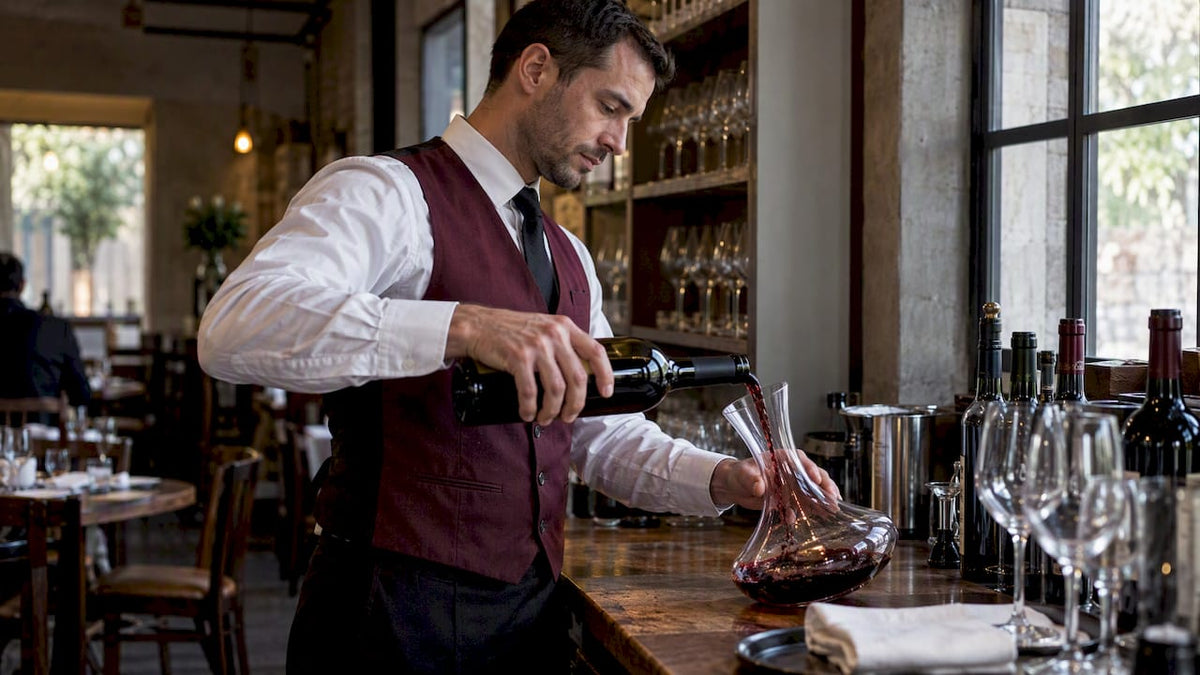
Decanting vs. Aerating: How to Choose for Each Bottle
Decanting and aerating both add oxygen, but they solve different problems. Learn which to use for old, young, white and large-format wines, and why.
Decanting and aerating both bring wine into contact with oxygen, but they do different jobs. Decanting is the slow, gentle transfer of a whole bottle into another vessel, chiefly to leave sediment behind. Aerating is a quick, mechanical way to push air into wine, usually a glass at a time, to loosen up a young, tannic red. Choose by the wine in front of you: old and fragile means decant, young and tight means aerate, or decant for longer.
The rest of this guide explains how to tell which case you have, what each method does to the wine, and how the answer changes when the bottle is a magnum or larger, where the real challenge is often not the wine but the weight.
TL;DR
-
Decanting treats the whole bottle over minutes to hours and separates clear wine from sediment. Aerating treats a glass or a pour in seconds.
-
Older, delicate reds generally call for a careful decant just before serving. Young, tannic reds can take an aerator or a long decant.
-
No technique revives a bottle that is past its prime. Over-exposure can harm fragile vintages.
-
Some full-bodied or reductive white wines also benefit from air, so the old “never decant white” rule is too blunt.
-
With magnums and larger bottles, stable support matters as much as the method, because lifting and tilting a heavy bottle stirs sediment.
Table of Contents
What each method actually does
Both approaches rest on the same principle: oxygen softens tannins and lets aromatics develop. Sommelier guidance frames the difference in operational terms. Decanting is a deliberate, time-intensive process used mainly to remove sediment from older wines or to let young ones breathe slowly. Aerating is a near-instantaneous mechanical step for young, tannic wines.
A useful definition comes from a winery’s explainer: aerating is deliberately invigorating wine with air to change aroma and flavor, while decanting is separating clear wine from sediment, which by default also aerates a little, but much more gently.

That gentleness is the point. An aerator works in the moment of pouring. A decanter works in the background, while you do something else.
The decanter: time, sediment and ceremony
Decanting serves two purposes, aeration and sediment separation. Most red wines throw sediment as they age. It is harmless, but it is gritty and bitter in the glass, so you want it to stay in the bottle.
Timing depends on the wine. Young, tannic wines typically need 30 minutes to 2 hours of exposure, while older, fragile wines should be decanted only immediately before service to prevent rapid oxidation.
The aerator: speed and control over a single glass
An aerator draws air into the wine as it flows through. One retailer’s comparison puts it neatly: an aerator treats one glass in seconds, a decanter treats the whole bottle over hours, and neither turns a wine into something it was not born to be. That last point is worth remembering before you reach for either.
Which wines suit which method
The dividing line most writers draw is age. One common rule of thumb lists three reasons to decant: an old red you want to separate gently from its sediment, a young wine that needs opening up, and simply for the drama. The table below turns that into a quick decision aid.
| Wine | Main goal | Better approach |
|---|---|---|
| Mature red with visible deposit | Separate from sediment, minimal air | Decant carefully, just before serving |
| Young, tannic red (for example, a powerful Cabernet or Nebbiolo) | Soften tannin, open aromatics | Aerate by the glass, or decant for 30 minutes to 2 hours |
| Tight, closed young wine, short on time | Quick opening | Aerator, or a rapid pour into a decanter |
| Full-bodied or reductive white | Blow off struck-match or sulfur notes | Moderate, careful air exposure |
| Tired, over-oxidized bottle | None possible | Neither: no technique restores lost fruit |
Old wines: non-intervention
With aged bottles, the professional instinct is restraint. Master sommeliers describe decanting as an act of care and favor minimal air contact beyond what is necessary to remove sediment. An aerator is the wrong tool here, since it forces oxygen into a wine that may only have hours of good life left once opened.
The same sources warn that over-aeration or too long in a decanter can do more harm than good, especially with fragile older vintages.
Young wines: muscle needs air
For young, muscular wines the logic reverses. Professionals may double-decant, pouring into a decanter and back into the bottle, to maximize oxygen exposure. If you have an hour or two, a decanter is a gentle way to do this. If guests are already seated, an aerator on the first pours is a sensible shortcut.
What about white wine?
The belief that white wines should never be decanted is outdated. Full-bodied, complex whites such as mature Chardonnay, and reductive styles, can benefit from moderate oxygen exposure that blows off sulfur-like or struck-match notes. Light, aromatic whites rarely need it.
Whiskey and spirits
Readers often ask whether spirits belong in a decanter. Whiskey and other spirits generally do not need aeration the way tannic red wine does. A decanter is acceptable for display or for removing sediment from some aged spirits, but it does not mature the liquid.
When neither will help
The most frequent mistake is trying to fix a wine that is simply past its prime. Sommelier guidance is blunt on this: no aeration technique can restore fruit to a tired, over-oxidized bottle. If a wine smells flat and faded on opening, the kind choice is to pour a small taste, enjoy what is there, and not push it with more air.
It also helps to taste before you decide. Pour a small amount when the bottle is opened. If it is tight and closed, give it air. If it is already open and generous, serve it as it is.
A practical decision path
-
Check the age and style. Is it old, with likely sediment, or young and structured?
-
Check the time you have. Under ten minutes points toward an aerator for a young wine. An hour or more opens the decanter option.
-
Taste a splash. Let the wine tell you whether it needs help.
-
For sediment, stand the bottle upright beforehand if the cellar allows, so the deposit settles toward the base.
-
Pour steadily, with a light behind the neck. Professional service uses a candle or light source to watch sediment in real time, and the bottle should not be tipped back once sediment reaches the shoulder.
-
Skip the coffee filter. Professionals regard filtering as detrimental to the wine’s character.
The large-format problem
Everything above assumes you can handle the bottle with ease. A standard bottle weighs little enough to tilt with one hand. A magnum holds 1.5 liters, a double magnum 3 liters, and the bigger formats such as the jeroboam and methuselah climb quickly from there. Fill any of them and the weight shifts the moment you tilt, which is exactly when sediment gets stirred.
For magnums and above, professional standards point to a decanting basket or cradle to keep the bottle stable, so there is no need to lift or shake the heavy vessel. The Court of Master Sommeliers describes professional decanting as theater and precision, a graceful, visible ritual, and for large bottles that requires tools that maintain absolute control.

An aerator does not solve this problem, because it still needs a bottle that someone must lift and tilt. A decanter does not solve it either, since the transfer is the difficult part. The cradle addresses the step in between: how the bottle moves.
Our perspective
We build wine cradles in Austria, so we watch this question from an unusual angle. Most advice about decanting versus aerating treats the bottle as a given, something that simply pours. With large formats it does not. A great deal of weight has to move very gently, and the moment you tilt it the load shifts and wants to keep going.
That is why we designed MagnuMaster around a dual-pivot mechanism. It lets you pour a heavy bottle smoothly and precisely with one hand, and it helps keep sediment undisturbed. The cradle does the work of controlling the bottle, so you can concentrate on the wine and the guests.
Our view on the main question is simple. Choose decanting or aerating for the wine’s sake, and choose your handling method for the bottle’s sake. With a large-format bottle of an aged red, the best service is often a slow, steady pour from a cradle, directly into a decanter or into glasses, with air treatment kept to what the wine genuinely needs. Pouring slowly from a cradle also gives a natural, gentle aeration without any gadget. And a wine that does not need either should simply be poured well.
Mathias Laurin Koidl, MagnuMaster
Serving large formats with a cradle
If you collect, serve or sell magnums and larger bottles, MagnuMaster is built for exactly this moment. The range has three models, matched to bottle size:
-
MagnuMaster L: bottles from 0.75 to 6 liters
-
MagnuMaster XL: bottles from 3 to 18 liters
-
MagnuMaster XXL: bottles from 5 to 30 liters
Each is handcrafted in Austria, works with one hand, and includes personalized engraving. The standard finish is anthracite with an iron-glimmer effect. If you want a different look, custom powder-coating is available for a one-off 550 €, which suits a hotel palette or a gift. You can see the full range on the MagnuMaster collection page, or read about engraving and custom finishes.

Common mistakes to avoid
-
Decanting too early. An old wine left for hours can fade before anyone drinks it.
-
Using an aerator on a fragile vintage. Speed is the opposite of what an old wine wants.
-
Treating air as a cure. It will not repair a tired bottle.
-
Lifting a heavy bottle by hand. Weight and imbalance disturb sediment and risk spills.
-
Filtering through coffee filters or cloth. It strips character and is considered poor service.
FAQ
Is it better to decant or aerate wine?
Neither is better in general. Decant older wines with sediment, carefully and shortly before serving. Aerate young, tannic reds when you want quick softening, or decant them for 30 minutes to 2 hours if time allows.
Can you use both a decanter and an aerator?
Yes, though it is rarely necessary. A young, very tight wine can go through a decanter first and then be poured through an aerator if it is still closed. For an old wine, using both risks over-exposure.
Do aerators work with white wine?
They can, but only for some styles. Full-bodied, complex or reductive whites may gain from a little air, while delicate, aromatic whites usually do not need it. Taste first and go gently.
Is it okay to put whiskey in a decanter?
It is fine for presentation, and for separating sediment in some aged spirits. It will not improve the whiskey the way air can soften a tannic red wine.
How do you decant a magnum without disturbing the sediment?
Avoid lifting and shaking the bottle. Professional standards recommend a cradle or basket to hold large bottles steady, and a slow, continuous pour with a light behind the neck so you can stop as sediment approaches the shoulder.

