
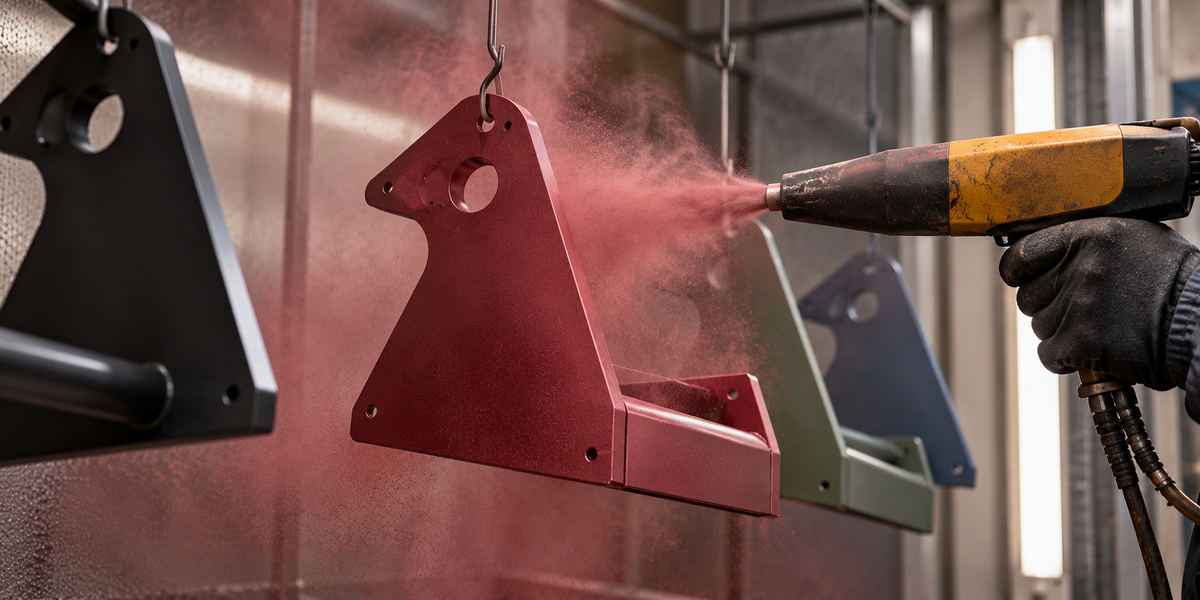
Powder Coat Durability: What It Really Means for Your Metal
How durable is powder coating? Real lifespans, the tests that prove it, what causes failure, and how to judge a custom finish on premium metal equipment.
Powder coating is one of the toughest finishes you can put on metal. Well-applied coatings in outdoor conditions often last 15 to 20 years, and premium architectural grades can exceed 30. But the number on the label matters far less than three things you can actually check: the resin chemistry, the preparation of the metal underneath, and how the coating was cured.
This guide explains how powder coat durability works, how it is measured, why some finishes fail early, and how to judge a custom finish on a piece of equipment you intend to use for decades, such as a wine cradle that will be handled at every serving.
TL;DR
- Quality powder coating typically lasts 15 to 20 years outdoors, and indoors, away from UV and weather, a good finish can outlast that considerably.
- It is generally tougher than liquid paint: a dense, cross-linked layer that resists chips, scratches and UV fading better.
- Preparation decides everything. Contaminated or poorly pretreated metal will defeat even the best powder.
- Ask for facts, not adjectives: resin type, cure validation, adhesion testing and, for exterior work, a weathering class.
- For a hand-held, frequently touched object, a well-specified powder coat is a sound choice for a finish that has to look refined for years.
Table of Contents
- What powder coating actually is
- How long powder coating lasts in practice
- Powder coat versus liquid paint
- Preparation: where durability is won or lost
- How durability is tested
- Weathering classes: useful, but know when they apply
- Seven things to ask before you trust a finish
- Caring for a powder-coated object
- Why durability matters beyond looks
- Our perspective on powder coating and large-format wine
- Choosing a finish for your MagnuMaster cradle
- Common myths about powder coat durability
- FAQ
- Sources
What powder coating actually is
A liquid paint is a pigment suspended in a solvent that evaporates as it dries. Powder coating works differently. A dry, finely ground mixture of resin, pigment and additives is electrostatically sprayed onto a grounded metal part, then baked. The powder melts, flows and chemically cross-links into a continuous film.
That last step is the heart of durability. Thermoset resins such as polyester and TGIC-based systems form a permanent, cross-linked bond that will not re-melt, unlike thermoplastic powders, which can re-flow under heat. Once a thermoset powder has cured, it is no longer a coating sitting on the metal so much as a hardened skin bonded to it.
There is no solvent to evaporate, which is why powder can be applied in a thicker, more uniform film than many liquid systems. Industry guidance puts the typical film at roughly 2 to 5 mils (50 to 125 microns), though the right thickness depends on the powder and the part.
How long powder coating lasts in practice

The headline figure most searchers meet is 15 to 20 years. The Powder Coating Institute states that high-quality coatings outdoors often last between 15 and 20 years, with premium architectural-grade coatings exceeding 30 years with minimal maintenance. Some coaters advertise up to 40 years. Treat that as a best case under ideal conditions, not a promise.
What matters is the environment:
| Environment | Main stress | What to expect |
|---|---|---|
| Indoors, handled objects | Abrasion, skin oils, light knocks, cleaning | The longest service life, if the finish is cured properly |
| Covered outdoor | Humidity, temperature swings | Good, with a UV-stable resin |
| Fully exposed outdoor | UV, rain, salt, pollution | 15 to 20 years for quality coatings, more for architectural grades |
| Coastal or industrial | Salt spray, chemical fallout | Needs a higher-class system and pretreatment |
Indoor objects are spared the harshest enemy, ultraviolet light, which is what fades and chalks a finish over time. A piece that lives in a cellar, dining room or tasting room faces a different test: repeated contact. Handling, a ring brushing a surface, a cloth with a little polish on it. This is where hardness, adhesion and scratch resistance count more than weathering class.
Powder coat versus liquid paint
Powder coating is generally more durable than liquid paint. The Powder Coating Institute attributes this to a dense, cross-linked thermoset layer that gives better chip and scratch resistance, along with significantly better UV resistance, so there is less fading and chalking.
Two honest caveats belong beside that claim.
- Repair is harder. A scratched liquid-painted part can often be touched up invisibly. Powder coating is difficult to spot repair, and a deep chip generally means refinishing the whole part.
- Application quality varies. A badly applied powder coat can lift or peel. That is a process failure, not a property of the material, and it is why the next sections matter.
For a premium object you want to keep for decades, the trade-off usually favours powder: you get a harder surface that resists daily wear, and you accept that major damage means a proper refinish rather than a dab of paint.
Preparation: where durability is won or lost
If you remember one thing from this article, make it this one. Industry experts consistently stress that a finish is only as good as the substrate beneath it. Surface cleanliness, pretreatment chemistry and curing are, according to Gordon Inc.'s technical material on architectural powders, the primary determinants of long-term success, and even the most advanced coating fails when the metal underneath is contaminated.
In practice, a reputable coater cleans and degreases the metal, removes oxidation, applies a chemical pretreatment that improves adhesion and corrosion resistance, rinses, dries, coats and cures. Skip or compromise any of these steps and the failure usually shows up months later, as bubbling, flaking edges or creeping corrosion beneath the film.

The type of metal matters too. Cast aluminum is a known difficulty: according to a QUALICOAT technical research paper on coating aluminum castings, contaminants within the casting can make the pretreatment and coating of cast parts a real challenge. Gordon notes that high silicone content in aluminum castings can make rigorous corrosion tests hard to pass without specialized pretreatment. Marketing copy rarely mentions this. A craftsperson who works with machined or fabricated metal parts, and who controls the preparation, starts from a more predictable base.
How durability is tested
A finish that claims to be durable should be able to point to standardized tests. The same few come up again and again.
- Impact resistance (ASTM D2794): measures how well the coating deforms without cracking when struck.
- Dry adhesion, cross-hatch (ASTM D3359): a grid is cut through the film and tape is applied to see whether squares lift. It confirms the bond.
- Solvent resistance, MEK rub (ASTM D5402): a solvent-soaked cloth is rubbed over the surface to verify the coating has fully cured chemically. An under-cured film softens or comes away.
- Film thickness (ASTM D7091): confirms the coat sits within the specified range.
The first three are described in peer-reviewed research on electrostatic powder coating. Professional finishing lines run the MEK and cross-hatch checks routinely, and one coater’s published quality program lists daily MEK rub tests and cross-hatch adhesion tests as standard practice. When a coater can describe these checks without hesitation, that is a good sign.
Weathering classes: useful, but know when they apply
For exterior architectural work, powder coatings are classified by how they hold up in Florida exposure trials, which combine intense UV, humidity, heavy rain and salt. Class 1, 2 and 3 tiers are a better indicator of longevity than a generic “powder-coated” label.
The numbers are specific. Under the QUALICOAT specification, class 1 finished products must retain at least 50% of their gloss, while class 2 products must retain at least 75% after one year in Florida and at least 60% after two.
These classes were written for building facades, window frames and similar exposed elements. If your piece lives indoors, UV resistance is a bonus rather than the deciding factor. Still, a coating with a strong weathering record tells you the resin chemistry is sound, and it keeps color stable if the object sits near a sunny window or a terrace.
Seven things to ask before you trust a finish
- What resin system is used? Thermoset polyester or polyurethane for stability, not a thermoplastic that can re-flow under heat.
- How is the metal prepared? Cleaning, degreasing and chemical pretreatment should be described, not assumed.
- How is cure verified? Look for a bake schedule and a solvent rub or equivalent check.
- Is adhesion tested? Cross-hatch results show the bond is secure.
- What is the film thickness? Too thin gives poor protection, too thick can crack or orange-peel.
- What gloss and texture? Matt and textured finishes hide fingerprints and small marks better than high gloss.
- What is the repair plan? Ask whether the maker can refinish the piece if it is ever badly damaged.
None of these questions is hostile. A maker proud of the work welcomes them.
Caring for a powder-coated object
A good finish asks for very little, but a few habits keep it looking new for longer.
- Wipe with a soft, damp cloth and mild soap. Dry afterwards.
- Avoid abrasive pads, scouring powders and strong solvents.
- Keep wine, which is acidic, from sitting on the finish. Wipe drips promptly.
- Do not use polish or wax unless the manufacturer says it is suitable.
- Handle with clean hands; skin oils are the most common source of dull patches on frequently touched pieces.
For a deeper look at chemical exposure, the cure check matters again: a fully cured thermoset film is far more resistant to wiping and cleaning than one baked at the wrong temperature.
Why durability matters beyond looks
A longer-lasting finish is also a sustainability argument. When a product lasts longer, it delays repair, refinishing or replacement, which reduces the raw materials, energy and transport consumed across its life. For a piece bought once and kept for a lifetime, or handed on, this is the sensible way to think about cost: not the price of the finish, but the number of years before you need to think about it again.
Our perspective on powder coating and large-format wine
We have built wine cradles in Austria since 2011, and we think about finish the way a collector thinks about a cork: invisible when it works, unforgettable when it does not.
A cradle for a magnum or a double magnum is handled in a very particular way. A great deal of weight moves very gently, usually in front of guests, usually in good light. Hands rest on the same points again and again, glasses and bottles come close to the metal, and the piece is cleaned between services. A finish on an object like that has to survive contact, not weather.
That is why the finish is a design decision and not a decoration. Our standard finish is anthracite with an iron-glimmer effect, chosen because it looks composed against glass, wood and linen and does not show every touch. Where a customer wants something different, whether to match a winery’s brand color, a hotel’s interior or a private cellar, we offer custom powder-coated finishes for a one-off fee of 550 €. Personal engraving is included with every unit.
Our advice to anyone choosing a custom finish is the same advice we give about pouring: slow down. Choose a color you will still want in ten years. Prefer a matt or satin surface for something handled often. Ask your maker how the metal is prepared and cured, because that is the part you cannot see. And remember that the finish is only one half of the experience. The other half is how the cradle moves in your hands, which is what our dual-pivot mechanism is built for.
— Mathias
Choosing a finish for your MagnuMaster cradle
The MagnuMaster range covers three sizes: L for bottles from 0.75 to 6 liters, XL for 3 to 18 liters, and XXL for 5 to 30 liters. Each is handcrafted in Austria, operates with one hand through the dual-pivot mechanism, and carries your engraving as standard.
If the anthracite iron-glimmer finish suits your setting, you need do nothing more. If you want a finish matched to a venue, a brand or a collection, the custom powder-coating option is priced at 550 € one-off. You can explore the complete large-format wine decanting cradle range, or go straight to a model: the MagnuMaster L, the MagnuMaster XL or the MagnuMaster XXL.
Common myths about powder coat durability
“Powder coating never chips.” It resists chipping better than most liquid paints, but a hard impact on a sharp edge can still break the film. Impact testing exists precisely because the limit is real.
“All powder coating is the same.” The resin, the pretreatment and the cure differ widely. Two parts that both count as powder-coated can differ by decades in service life.
“Thicker is always better.” Thickness within the specified range protects. Beyond it, you risk poor flow and cracking.
“It is only for outdoor use.” Powder coating is common indoors, on appliances, furniture and fine hardware, because the hard surface handles daily contact well.
“A long warranty proves a long life.” A warranty tells you what a seller will stand behind. The tests, the preparation and the resin tell you why.
FAQ
How many years does powder coating last?
High-quality powder coating outdoors often lasts 15 to 20 years, and premium architectural grades can exceed 30, according to the Powder Coating Institute. Indoors, where UV and weather are absent, a properly prepared and cured finish can last longer. Preparation and cure quality matter more than any single number.
Is powder coating more durable than paint?
Generally yes. The cross-linked thermoset film resists chips, scratches and UV fading better than most liquid paint. The trade-off is that spot repairs are harder, so serious damage usually means refinishing the whole part.
How can I check powder coating quality?
Ask how the metal is pretreated and how the cure is verified. Professional coaters run a solvent rub test (ASTM D5402) for cure and a cross-hatch test (ASTM D3359) for adhesion. Check visually for even coverage, consistent texture and clean edges, with no bubbling or thin patches.
Does custom powder coating on a wine cradle cost extra?
Yes. Our standard finish is anthracite with an iron-glimmer effect, and custom powder-coated finishes are available for a one-off fee of 550 €. Engraving is included with every unit at no extra charge.
Sources
- Powder Coating Institute: Sustainability and durability
- QUALICOAT UK & Ireland: Why Florida test architectural powder coating
- QUALICOAT: Appendix to the specifications, 26th edition
- QUALICOAT: Coating aluminium castings, technical research paper
- Gordon Inc.: architectural powder coatings
- BioResources: electrostatic powder coating, adhesion and scratch resistance
- Monti: powder coating brochure

