
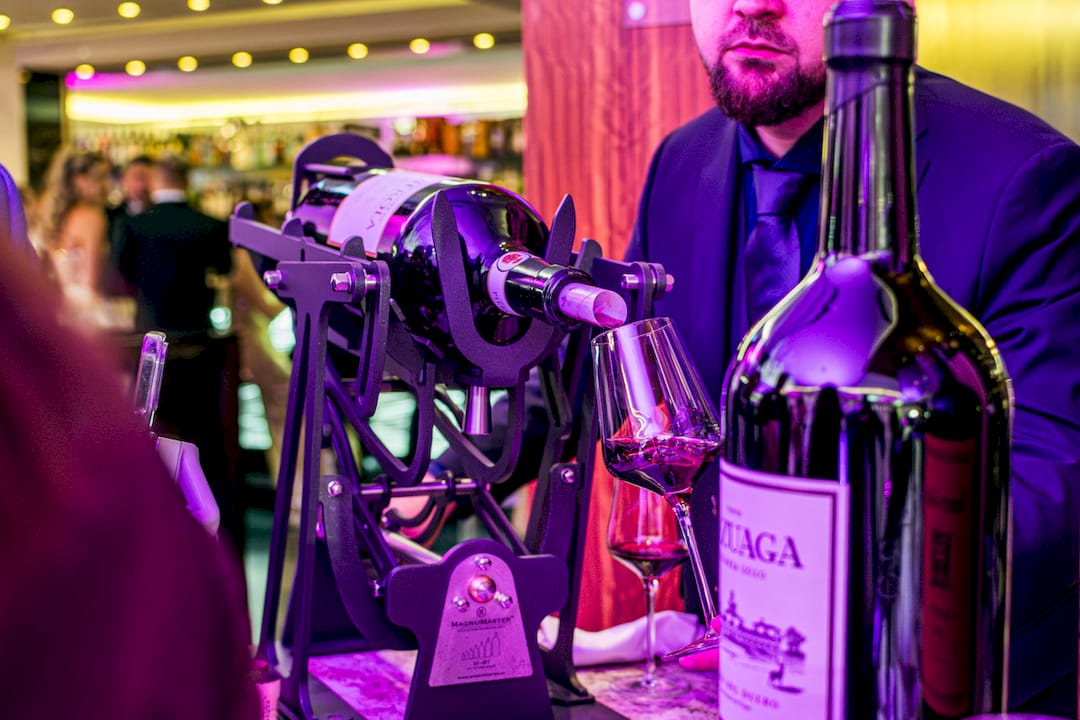
How to Serve a 9-Liter Salmanazar: Preparation and Pouring
A practical guide to serving a 9-liter Salmanazar: preparation, safe positioning, controlled pouring, sediment care and a step-by-step checklist.
A Salmanazar holds 9 liters, the equivalent of 12 standard 750 ml bottles, and it is served well only when you plan the handling before you plan the wine. Chill or settle it ahead of time, secure it in a stable cradle, open it with control, and pour slowly with as little movement as possible. Done this way, a bottle that usually draws nervous glances becomes the highlight of the evening.
This guide is about the 9-liter format and nothing else: what it demands, how to prepare it, where to put it, how to pour it, and what to do when the wine is old and carries sediment.
TL;DR
-
A Salmanazar is 9 liters, or 12 standard bottles. Our estimate for a full bottle is well over 9 kg of liquid alone, before the weight of the glass.
-
Prepare early: chill or rest the bottle in advance, clear the space, and agree who does what before the first guest arrives.
-
Never lift and tilt it freehand. Use a cradle that holds the bottle at its center of gravity, and keep the movement slow and continuous.
-
For aged wine, stand the bottle upright in advance and avoid any unnecessary movement, then pour steadily until sediment approaches the neck.
-
The MagnuMaster XL is made for bottles from 3 to 18 liters and covers the 9-liter size.
Table of Contents
What a 9-liter Salmanazar really is
The Salmanazar is one of the classic large formats, three times the size of a magnum’s 1.5 liters in volume terms is not quite right; it is six times a magnum. Think of it as one case of wine in a single bottle. Poured into glasses, the arithmetic is simple:
| Pour size | Glasses from 9 liters |
|---|---|
| 125 ml (a typical sparkling pour) | 72 |
| 150 ml (a generous still-wine pour) | 60 |
These figures are our own division of 9,000 ml by the pour size, so treat them as planning numbers. In practice, you lose a little to sediment in an old bottle and to foam in a sparkling one.
Weight: a verified fact and an estimate
We separate what is verified from what is estimated, because that distinction matters when you are about to lift a bottle over a table.
-
Verified: the volume is 9 liters, equal to 12 standard bottles.
-
Estimate: wine is close to the density of water, so 9 liters of liquid weighs roughly 9 kg (about 20 lb). The glass adds a considerable amount, and a sparkling-wine bottle is thicker and heavier than a still-wine bottle. Expect a full Salmanazar to be a two-person lift.
The exact figure varies by producer and glass, so weigh your own bottle if you need a number, for instance when checking a shelf or a serving table.
Why it is hard to handle
A standard bottle is lifted and tilted without thinking. A Salmanazar behaves differently for three reasons.
-
Weight and balance. The moment you tilt it, the load shifts and wants to keep going. A small tilt that was safe becomes a large pour in a second.
-
Slow response. With nine liters inside, the liquid keeps moving after you stop tilting. Corrections must be made early and gently.
-
Wine disturbance. Every lift, shake and re-tilt stirs the contents. In an aged wine, that means sediment lifting off the bottle’s side.
The common professional workaround is to avoid freehand pouring altogether. Guidance for service staff on large formats calls for a pouring cradle, at least two handlers, and secure positioning so nothing can tip, especially in crowded rooms. Many hosts also open the big bottle for display and then serve guests from smaller bottles or carafes. That is a sound approach for a large party. When you want to pour directly from the Salmanazar for the guests to see, the rest of this guide shows how to do it safely.
Preparing the bottle
Preparation decides most of the outcome. Do these things well before service.
Temperature and resting time
A 9-liter bottle changes temperature slowly. A bottle that goes into an ice bucket 20 minutes before service will still be warm at its core. Plan on a long, even chill in a cool room or cellar rather than a rushed one, and bring it to the service location early so it is not carried around when guests are present. The right temperature depends on the wine, so follow the producer’s guidance for that bottle.

Sediment: stand it up
If the wine is aged and has been lying on its side, stand the bottle upright in advance, ideally a day before, so the sediment can settle toward the base. Moving a Salmanazar that has just been stood up will undo that work, so choose its service spot first and stand it there. This is the most useful single step for an older red.

Clear the space
Before the bottle arrives, check:
-
A firm, level surface that can bear the combined weight of bottle and cradle.
-
A clear path from storage to the table, free of steps, cables and crowds.
-
Enough room around the bottle for two people to work without leaning over guests.
-
Clean glasses, lined up and within easy reach. Court of Master Sommeliers service standards state that glassware must be clean, and that tulips or flutes suit sparkling wine.
-
A clean napkin to wipe the lip after pouring.
Agree the roles
Decide who steadies the bottle and who handles the pour. It sounds formal, but a Salmanazar is a team effort, and the plan only needs thirty seconds.
Safe positioning
Where the bottle sits matters as much as how you pour.
-
Keep it low and stable. A heavy bottle belongs on a sturdy table or stand at a comfortable working height, never on the edge of a surface.
-
Keep guests out of the line of fire. For a sparkling wine, the cork direction is your first safety decision. Point it away from people, glass and anything breakable.
-
Use a cradle. A cradle takes the weight off your hands and lets the bottle move through a controlled arc rather than a freehand tilt. Professional guidance for bottles larger than 6 liters points to a pouring cradle and at least two handlers, as Wikeeps notes in its champagne size guide.
Opening a sparkling Salmanazar
If the bottle is sparkling, opening it is the part that needs the most care. The Court of Master Sommeliers standards describe the method:
-
Remove the foil.
-
Keep your thumb firmly over the cork while loosening the cage.
-
Point the cork away from guests.
-
Twist the bottle, not the cork, at a 45° angle, and release the cork with little or no noise.
With a heavy bottle, have your second person steady it during this step. A dramatic pop is not the goal. A quiet release keeps the wine calm and the room safe. For a still wine, the same principle applies: open it slowly and keep the bottle as still as you can.
Controlled pouring
General service guidance is useful here. The Nicolet College wine service chapter advises using two hands for large formats, holding the bottle around the body, and wiping the lip with a clean napkin. It also recommends keeping the label facing the guest. With a Salmanazar, add these habits.
-
Pour in one slow, continuous motion. Hesitation and re-tilting cause surges.
-
Do not fill to the top. The Court of Master Sommeliers standards suggest filling glasses one-third to one-half full, depending on the glass, which also gives guests room to swirl and gives you more glasses from the bottle.
-
Pour a test glass first in a small, unobtrusive glass if the wine is sparkling, to read the foam.
-
Return the bottle to upright slowly. The dangerous moment is often the return.
-
Mind the cadence. Sparkling wine kept in a bucket of ice water between pours holds its temperature better, as the Nicolet chapter notes. With a 9-liter bottle, this is hard to do, so plan your service pace so that glasses are filled in a few concentrated rounds rather than a slow trickle across the evening.
Serving aged wine with sediment
Sediment is a sign of age and not a fault, but you want it to stay in the bottle. The principle is to minimize unnecessary movement.
-
Stand the bottle upright well ahead of service, as described above.
-
Move it once. Place the bottle in its cradle in its final location, ideally before guests arrive.
-
Tilt slowly and keep the angle steady. The Court of Master Sommeliers guidance for service in a basket says to place the bottle carefully with the label upward and pour slowly and steadily until sediment appears in the neck. The same logic applies to a cradle.
-
Stop when the sediment arrives. In a 9-liter bottle, the last portion in the neck may be a few glasses’ worth. Leave it. You will have served the clear wine in excellent condition.
-
Do not return to pour again later if you can help it. Each return trip lifts the sediment again.
The benefit of a good cradle is that the movement is smooth and small. You change the angle in tiny increments, and the wine travels along the bottle’s side rather than churning.
How the MagnuMaster XL helps
We designed the MagnuMaster XL for exactly these conditions. It takes bottles from 3 to 18 liters, so a 9-liter Salmanazar sits comfortably in its range. These are the product facts that matter for this size:
-
Proprietary dual-pivot mechanism. It is designed to give smooth, precise, controlled pouring and to help minimize sediment disturbance.
-
Precision crank. The bottle is tilted in measured increments rather than lifted and tipped by hand, which suits the slow, steady movement an aged wine needs.
-
One-hand operation. The mechanism is designed so a single hand can operate it, which leaves your other hand free to steady the glass or the bottle.
-
Natural aeration and sediment separation. The pouring action is designed to aerate the wine gently and keep the sediment back.
-
Finish and engraving. The standard finish is anthracite with an iron-glimmer effect, and personalized engraving is included with every unit. A custom powder-coated finish is available for an additional €550.
-
Handcrafted in Austria since 2011.
A cradle does not replace good preparation, and a second person is still wise when you first position the bottle. What it changes is the pour itself: the weight is carried by the device, so you can concentrate on pace and angle.
Note on what we have not measured. We do not publish a stated glass count or weight for a Salmanazar in the XL, and the numbers in this article are general planning figures. Always confirm the fit of your particular bottle with its dimensions.
Step-by-step serving checklist
The day before
-
Stand an aged bottle upright so the sediment can settle.
-
Check that the table or stand can bear the weight.
-
Confirm clean glassware in the right shape and in sufficient number (60 to 72 for a full bottle, using the planning figures above).
Two hours before
-
Move the bottle to its final location once, with two people.
-
Set the bottle in the cradle and check that it is stable.
-
Let the temperature settle, and keep the room cool.
At service
-
Clear the area around the bottle and agree who is doing what.
-
If sparkling, open it using the 45° twist method, thumb on the cork, pointed away from guests.
-
Wipe the lip with a clean napkin.
-
Tilt slowly and pour in one continuous movement, one-third to one-half of each glass.
-
Keep the label toward the guests.
-
For aged wine, stop when sediment approaches the neck.
-
Return the bottle to upright slowly, and leave it in place.
Our perspective
We built the MagnuMaster because serving large formats well is mostly a question of physics. A great deal of weight has to be moved very gently, and a person’s arms are not the right tool for that. A Salmanazar deserves the same calm, deliberate pour as any fine bottle, and the cradle should disappear into the ritual.
In our experience, the bottles that suffer most are the oldest ones. Sediment does not forgive a hurried lift. That is why the dual-pivot mechanism, the precision crank and the single-handed operation matter to us: they let you tilt in small, steady steps and keep the wine undisturbed.
The XL is, for most collectors and venues who serve 9-liter bottles, the right size. It is built for 3 to 18 liters and handcrafted in Austria. If you only serve magnums and smaller formats, the MagnuMaster L may suit you better. Whichever you choose, the aim is the same: that the first pour is a moment guests remember.
Mathias Laurin Koidl
Choosing the right MagnuMaster
For a 9-liter bottle, the MagnuMaster XL at €3,300 is the model to look at. It covers 3 to 18 liters, so it also handles jeroboams, rehoboams, methuselahs and imperials if your collection grows. If you mostly serve magnums and bottles up to 6 liters, the MagnuMaster L at €2,580 is the smaller option, and it also takes standard 750 ml bottles.
Engraving is included with every unit, which makes either model a considered gift for a cellar, a winery or a hotel. You can also learn more about our range on the MagnuMaster home page.

If you would like the cradle to match your cellar or dining room, a custom powder-coated finish is available for an additional €550.
FAQ
How many glasses does a 9-liter Salmanazar serve?
Dividing 9,000 ml by your pour size gives 72 glasses at 125 ml and 60 glasses at 150 ml. These are planning figures, and an old bottle will yield slightly less because you leave the sediment behind. For a sparkling wine, fill glasses only one-third to one-half full for the best presentation.
Can one person serve a Salmanazar?
We advise against lifting or positioning it alone. Professional guidance for bottles larger than 6 liters recommends at least two handlers and a cradle. Once the bottle is positioned in a cradle such as the MagnuMaster XL, one person can operate the pour with one hand, but we still suggest a second person for the initial placement.
How do I avoid stirring sediment in an old bottle?
Stand the bottle upright well before service, place it in its cradle once, and tilt slowly in a steady, continuous motion. Stop pouring when sediment appears in the neck. Avoid carrying the bottle after it has settled.
Does the MagnuMaster XL fit a 9-liter bottle?
Yes. The XL is designed for bottles from 3 to 18 liters, and a 9-liter Salmanazar falls within that range. Bottle shapes vary by producer, so check the dimensions of your own bottle if it is unusual.
Is a Salmanazar better opened for display and served from smaller bottles?
For a large party, many hosts open the big bottle for show and serve from smaller bottles or carafes to keep service quick. If you want to pour straight from the Salmanazar, a stable cradle and a second person make it safe.


