
Wine Sediment Explained: What It Is and How to Pour Around It
What wine sediment is, why it forms as wine ages, and how to serve mature bottles, magnums included, with minimal disturbance to the deposit.
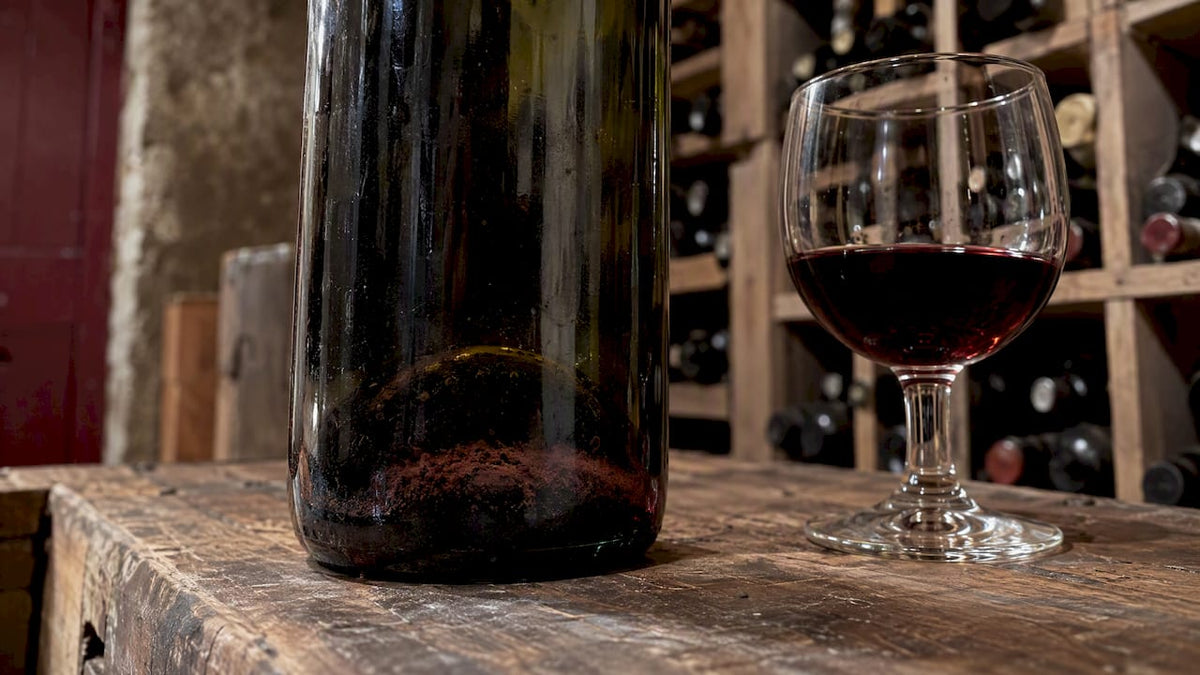
Sediment is the solid material that settles out of wine, and in a mature bottle it is normal, harmless and often a sign of a wine made with little intervention. The skill is not in avoiding it but in serving around it: stand the bottle upright, move it as little as possible, and pour slowly and steadily so the deposit stays behind. This guide explains what sediment is made of, why it forms, and how to handle it, with particular attention to magnums and larger formats, where weight makes gentle handling much harder.
TL;DR
-
Sediment is a natural byproduct of winemaking and ageing: grape solids, spent yeast and polymerized tannins and pigments in red wine, tartrate crystals in white. It is not a fault.
-
Stand the bottle upright beforehand, handle it gently and pour slowly with a light behind the neck, so you can stop before the deposit travels.
-
Not every mature wine should be decanted. Fragile old vintages can lose their bouquet quickly, so sometimes it is better to pour carefully and leave the last ounce in the bottle.
-
Large formats are where technique tends to fail, because a heavy, imbalanced bottle is hard to hold steady. The MagnuMaster dual-pivot cradle is built for exactly that problem.
Table of Contents
What wine sediment actually is
Wine sediment is the solid matter that drops out of a liquid over time and collects at the lowest point of the container, whether a bottle, tank or barrel. Wikipedia describes it) as a highly heterogeneous mixture, which is a useful reminder that “sediment” is a family of deposits rather than one substance.
In red wine, according to Food & Wine, it typically consists of:
-
grape solids such as skin, seeds and pulp;
-
spent yeast cells, known as lees;
-
polymerized phenolic compounds, meaning tannins and pigments that have bound together and accumulate over time.
In white wine, the visible deposit is most often potassium bitartrate crystals, sometimes called “wine diamonds,” which precipitate when the wine is cold. Decanter’s explanation of tartrate crystals notes that they are no cause for alarm and may even indicate quality-led winemaking decisions.
The two deposits look and behave differently. Tartrate crystals are small, hard and glittering, and you may find them on the base of a cork. Red wine sediment is soft, dark and silty, and it clouds a glass the moment it is disturbed. That second kind is the one that matters when you are serving.
Why sediment forms as wine ages
During bottle ageing, tannin and pigment molecules link into larger chains. Eventually these chains become too heavy to stay dissolved, and they fall out of solution. The Wine Spectator describes sediment as a natural consequence of making wine, made up of small bits of grape solids among other things.
Three factors decide how much a given bottle throws:
-
Age. The longer a wine ages in bottle, the more of its phenolic material has time to polymerize and settle.
-
Grape and vintage. Thick-skinned, tannic, deeply colored wines from structured vintages tend to build more of a deposit.
-
Winemaking choices. Heavy filtration and cold stabilization remove material before bottling. A producer who does less of either leaves more in the bottle, which is why sediment is common in traditional and low-intervention wines.
The WSET lists the usual suspects for deposits: vintage Port, red wines capable of ageing in bottle, and reds made with little filtration.
This is why experienced collectors read sediment differently from casual drinkers. In a Decanter piece, the late Master Sommelier Gerard Basset is cited as treating it as a hallmark of quality rather than a flaw, evidence that the producer put the wine’s full character and ageing potential ahead of predictability.
Is sediment safe to drink?
Yes. Wine Spectator’s answer is that sediment in an aged red is perfectly natural and safe, although it is unpleasant to drink. It is gritty and bitter, and it muddies the appearance of the wine. That is the whole case for keeping it out of the glass: texture and clarity, not safety.
One distinction is worth making. A clear wine with a settled deposit is normal. A wine that is cloudy and fizzing, or smells of vinegar or something off, is a different matter and has nothing to do with sediment. Judge the aroma, not only the appearance.
Serving wine with sediment: a practical routine
The approach below follows standard practice described by Decanter, and it works for any bottle size.
Before service
-
Stand the bottle upright in advance. Bottles stored on their side carry the deposit along the lower flank. Standing the bottle upright for a period before opening allows it to settle into the punt, the indentation at the base. Many practitioners allow several hours, and a day is common for older bottles.
-
Carry it like it is full of something fragile. Avoid turning it, tilting it back and forth or setting it down with a bump.
-
Open it without rocking. Remove the foil and cork steadily, holding the bottle still.
During the pour
-
Put a light behind the neck. A candle or a bright torch lets you see the deposit approaching the shoulder, so you can stop before it enters the decanter or glass.
-
Pour slowly and continuously. A single steady motion is better than stop-start pouring, which sends the sediment sloshing back and forth.
-
Stop early. The last ounce or so is usually where the deposit lives. Leaving it behind costs very little.
Keeping sediment out of the glass
If you are pouring directly into glasses, the same logic applies: pour one steady pass, avoid returning the bottle to upright between glasses where you can, and finish early. Each time the bottle swings upright and back, the deposit has a chance to travel.

To decant or not to decant
Decanting is the traditional answer to sediment, but it is not always the right one. Kerin O’Keefe argues in Decanter that for older wines the aeration is the real risk, and that the better practice is often to pour carefully and leave the sediment-heavy last ounce in the bottle.
The reasoning is simple. Aged wines have delicate, complex aromatics, and Decanter’s guide warns that rapid exposure to oxygen can make a bouquet collapse. Its advice is to decide based on whether there is a deposit, not just on a wish to aerate. If the wine has no sediment, serving it straight from the bottle may preserve its fragile state.
Two cautions follow:
-
If you do decant a mature wine, do it immediately before service, not hours ahead.
-
Be cautious about double decanting, where the wine is decanted, the bottle cleaned and the wine returned to it for presentation. Sommeliers point out that it doubles the wine’s oxygen contact, which can harm delicate aged vintages.
Neither point means decanting is wrong. Young, tannic reds often benefit, and Decanter’s guide to when and how makes the point that there are no absolute rules. It does mean that for many mature bottles the best tool is a careful pour straight from the original bottle, and that is where bottle size becomes the main variable.
Why magnums and large formats are harder
A standard bottle weighs a little over 2.5 pounds when full. A magnum holds 1.5 liters, a double magnum 3 liters, and from there the sizes climb quickly. As Wine Investment notes, a double magnum is equivalent to four standard bottles, and in Champagne it is called a Jeroboam, though in Bordeaux the same name means 4.5 liters. Naming varies by region, so volume is the safer way to specify.
Three things make these bottles difficult once sediment is involved:
-
Weight. Holding several kilos at a steady angle for the length of a pour tires the arm, and a tremor transmits straight into the liquid.
-
Imbalance. The center of gravity shifts as the bottle tilts. The moment you tip it, the load moves and wants to keep going, so the angle changes just when you need it constant.
-
Duration. A larger bottle takes longer to pour, which means more time in which a small error can stir the deposit.
Decanter’s guidance touches on the same point: large formats call for a specialized approach, because their size makes them prone to instability and because human error is hard to eliminate when you are holding heavy, imbalanced glass. Sommelier teams know the standard workarounds: two people, a towel, a table edge. They work, but they are improvised, and they are the reason many large-format pours end with a cloudy glass or a spill.
The role of the cradle
A pouring cradle holds the bottle at a consistent angle rather than relying on a hand to do it. The principle is long established with traditional decanting cradles: a stable orientation prevents agitation of the settled particles. The challenge with large formats is that a cradle must also carry the weight and tilt the bottle in a controlled way, rather than simply holding it still.

The dual-pivot approach
This is the problem MagnuMaster was designed around. Our proprietary dual-pivot mechanism lets a heavy bottle rotate in a controlled arc, so the angle changes gradually and the bottle stays balanced instead of lurching as it passes its tipping point. The result is smooth, precise pouring that you can manage with one hand.
What that means for sediment:
-
A consistent orientation. The bottle moves through a single steady path, so the deposit is not repeatedly stirred by shifting hands.
-
Control over speed. Slow pouring is the single most useful habit with mature wine, and a balanced mechanism makes slow pouring achievable at 6, 12 or 18 liters.
-
A free hand and a clear view. With the weight carried by the cradle, you can watch the neck against a light and stop at the right moment.
-
Natural aeration. The wine flows into the glass or decanter in a gentle stream, without a forced splash.
To be precise about what this does and does not do: the mechanism helps keep sediment settled in the bottle during service, and it supports the habits that matter. It does not remove or filter sediment, and no tool can guarantee a sediment-free pour. The last pour of any mature bottle still deserves the same attention and the same willingness to leave a little wine behind.
Our perspective
We have been building these cradles by hand in Austria since 2011, and the conversation we have most often with collectors and sommeliers is not about sediment as a concept. They know exactly what it is. It is about the moment of the pour: a double magnum of a treasured vintage, a table of guests watching, and a bottle that is heavier than anything else in the room.
In our experience, the common failures are not failures of knowledge. They are failures of handling. People know to stand the bottle up and to pour slowly. What they cannot easily do is keep a large, heavy bottle at a steady angle for several minutes without a tremor or a lurch. We designed the dual-pivot mechanism so that the bottle’s weight works for you rather than against you, and so that the pour is something you control rather than something you survive.
We would add a note of restraint. Sediment is not the enemy, and a cradle is not a way to make an old wine behave like a young one. The best service is quiet: the bottle upright beforehand, one unhurried pour, the last ounce left behind. Our job is to make that ritual possible at sizes where it is otherwise difficult.
— Mathias Laurin Koidl
Choosing a MagnuMaster for your bottles
The three models are sized by bottle volume, so the choice follows the largest format you plan to serve:
| Model | Bottle range | Price |
|---|---|---|
| MagnuMaster L | 0.75 to 6 liters | €2,580 |
| MagnuMaster XL | 3 to 18 liters | €3,300 |
| MagnuMaster XXL | 4.5 to 30 liters | €9,500 |
The MagnuMaster L covers standard bottles, magnums, double magnums and up to 6-liter formats, which suits most private cellars. For larger bottles, the MagnuMaster XL takes bottles from 3 to 18 liters. The XXL is made for the very largest bottles, up to 30 liters. You can see the range together on the MagnuMaster collection page.
The standard finish is anthracite with an iron-glimmer effect. Custom powder-coating is available for an additional €550, and personalized engraving is included with every unit, which is why many clients choose a cradle as a gift or as a signature piece for a cellar, restaurant or winery.

Common questions about sediment and large bottles
Does sediment in wine mean it is good?
Not by itself, but it often points to a wine that was not heavily filtered or stabilized, or one that has aged well in bottle. Sediment tells you about winemaking and age, not about quality on its own. Judge the wine by smell and taste.
Should I shake or stir the bottle to mix sediment back in?
No. Sediment is gritty and bitter, and mixing it in makes the wine cloudy and harsher. The point of careful service is to leave the deposit where it has settled.
How long should a bottle stand upright before serving?
Stand it upright in advance so the deposit can settle into the punt. Decanter’s guidance describes it as a period before opening, and practitioners commonly allow several hours or a day for older bottles. Handle it gently when moving it, because a bump can undo the settling.
Why is there crystal sediment in my white wine?
The crystals are most likely potassium bitartrate, also called tartrate crystals or wine diamonds, which form when the wine gets cold. They are harmless and flavorless, and they can be left behind in the bottle.
Is sediment more of a problem in magnums?
The sediment itself behaves the same way, but the handling is harder. A magnum or larger bottle is heavy and imbalanced, so keeping it steady for a slow pour is difficult, and a cradle that carries the weight makes controlled service much easier.


