
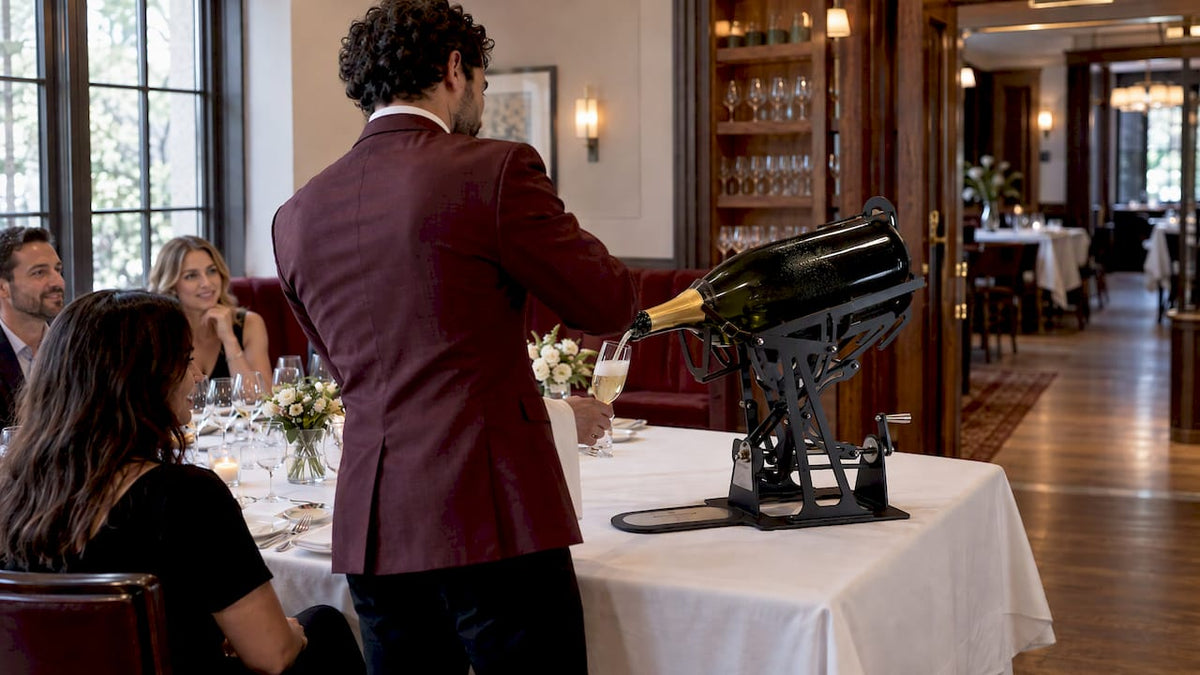
Serving Champagne from Large Formats: A Restaurant Guide
How to chill, open, handle and pour Champagne from magnums, jeroboams and larger bottles at the table, and where a pouring cradle like the MagnuMaster XL fits.
Serving Champagne from a large-format bottle comes down to four things: a properly chilled and settled bottle, a controlled opening, a secure way to carry the weight, and a pour made in stages. A magnum is manageable with practice. A jeroboam or larger is a different task, because the load shifts the moment you tilt it. This guide covers each step for restaurants, hotels and special occasions, and explains where a purpose-built cradle such as the MagnuMaster XL belongs in the routine.
TL;DR
-
Chill to about 8 to 10°C (46 to 50°F) and stand a jeroboam upright for at least 24 hours before opening.
-
Open with the bottle tilted to about 45 degrees, turning the bottle rather than the cork, and use both hands on a large format.
-
Pour a small amount into each glass first, then fill in stages once the foam settles.
-
Sparkling service differs from still: pressure, foam and the cork shape the whole routine.
-
Measure your bottle before buying any pouring aid. Not every Champagne bottle fits every device.
Table of Contents
Which bottles count as large format
In Champagne, the formats run from the quarter bottle up to the 30-liter Melchizedek, according to the Champagne trade body. The sizes you will meet most often at a table, with the number of 125 ml flute servings each provides according to Laurent-Perrier, are:
| Format | Volume | Flutes (125 ml) |
|---|---|---|
| Standard | 0.75 L | 6 |
| Magnum | 1.5 L | 12 |
| Jeroboam | 3 L | 24 |
| Methuselah | 6 L | 48 |
| Salmanazar | 9 L | 72 |
| Nebuchadnezzar | 15 L | 120 |
| Melchior | 30 L | 240 |
These counts are a planning guide for a measured pour. A restaurant pouring into larger tulip glasses will get fewer servings, so plan from your own pour size.
The practical point is that volume changes everything about handling. A full jeroboam holds 3 liters of wine, before the weight of the glass is added. Sparkling wine bottles are also built thick to withstand the pressure inside, so a large format is heavier than its volume suggests.
How bottle size and shape affect handling
Three things make large formats harder than a standard bottle:
-
Weight and balance. The center of gravity moves forward as you tilt, so the bottle wants to keep rotating.
-
Neck and shoulder geometry. Larger bottles have wider bodies and longer necks, and shapes differ from house to house. A grip that works on one bottle may not suit another.
-
Pour duration. A magnum empties more slowly than a standard bottle, and the bigger the bottle the longer your arm holds a load.
For a magnum or larger, the Court of Master Sommeliers service standards describe one hand supporting the neck while the other holds the bottle with a handshake or bottom grip. That works well for a magnum. Beyond a jeroboam, most staff need either two people or a mechanical aid.
Chilling and preparation
Temperature
The Champagne trade body gives an ideal serving temperature of about 8 to 10°C (46 to 50°F). It suggests an ice bucket half filled with water and ice for 20 to 30 minutes, or the bottom of a refrigerator for a few hours. Those timings are written with a standard bottle in mind. A large format holds far more liquid and cools more slowly, so plan on a longer, gentler chill and never rush it with a freezer.

Let the bottle rest
If the bottle has traveled or been moved from a cellar rack, rest it. Veuve Clicquot’s guidance says a jeroboam should stay upright for at least 24 hours before opening. For a banquet, build that into your prep schedule the day before.
Set up the station
The Master Sommelier standards call for two clean serviettes: one to present and dry the bottle and handle it during opening, the other to wipe the lip and catch drips. They also recommend underliners for the bottle and the cork. For the ice bucket stand, place it to the host’s right, within the host’s reach but clear of the sommelier’s movement.
Large formats also need floor space. Check that the route from the cellar to the table is clear and that the table has room for the bottle, glasses and a cradle or stand if you use one.

Opening a large-format bottle safely
Pressure is the reason sparkling service is its own discipline. Treat every bottle as pressurized and never point it at a guest or colleague. The sommelier standards describe this sequence:
-
Loosen the cage, then keep a firm grip on the cork and cage from that point on.
-
Tilt the bottle to about 45 degrees where possible.
-
Turn the bottle, not the cork, so the pressure escapes gently with a soft hiss.
-
On a large format, use both hands to stabilize the bottle if needed.
These steps come from the Master Sommelier guidelines. If a cork resists, do not force it. Stop, let the bottle settle and ask a colleague to help steady it. A large cork under pressure is no place for improvisation.
Sparkling service versus still wine service
The two share the need for control, but the priorities differ.
| Still large format | Sparkling large format | |
|---|---|---|
| Main concern | Sediment and aeration | Pressure, foam and temperature |
| Opening | Cork pulled, no pressure | Cage and cork held, bottle turned |
| First pour | Steady stream | Small amount, then pause for foam |
| Resting before service | Often stood upright to settle sediment | Rested upright, then chilled |
| Glass fill | Roughly a third to half | No more than half to two thirds, in stages |
With still wine, a slow, continuous motion protects the deposit. With Champagne, you work in stages because foam rises quickly, and the Union des Maisons de Champagne advises a small amount in each glass first, then filling after the bubbles subside.
Controlled pouring for a group
For a large bottle, support the neck with one hand. Pour a small amount into each glass, return to top up in stages, and keep glasses no more than half to two thirds full, as the Champagne houses’ guidance describes.
Some practical habits help:
-
Choose the glass first. The Champagne trade body says flutes and coupes are not best suited to showing Champagne’s full character and recommends a tulip-shaped glass. A wider bowl also tolerates a slightly faster pour.
-
Pour a first round, then a second. With a group, make one pass with small pours and a second pass to bring each glass to its level. This evens out portions across a table.
-
Wipe the lip between glasses. Use the second serviette so drips never reach the tablecloth.
-
Time the toast. The Champagne houses suggest pouring while the speech is being delivered, starting with the speaker, and giving each guest your full attention. Plan the bottle’s temperature around that timing.
-
Count your pours. Decide on a pour size before service and divide the bottle by it. Competitions test this skill: one UK sommelier contest task has asked contestants to pour a magnum into 16 glasses equally, without revisiting a glass or spilling.
Elegant tableside presentation
Presentation is part of the product at a large-format table. A few principles apply:
-
Present the bottle to the host with the label facing them before opening, using the clean serviette.
-
Keep movements slow. A large bottle moved quickly looks hurried and feels risky to guests.
-
Open at the table when the room and the guests’ positions allow it safely. Otherwise open at a service station and bring the bottle over.
-
Keep the ice bucket and stand within the host’s reach, as noted above.
-
Stay personable. Sommelier mentor Claire Thevenot is described as encouraging contestants to show personality and hospitality alongside technical skill. A large format is theater, so let the guests share it.
Perspective
We built the MagnuMaster because we saw the same moment repeat in dining rooms and cellars: a very heavy bottle, a nervous grip, and a pour that depended on how steady one wrist could stay for a minute or more.
Our dual-pivot mechanism lets the bottle move through its tilt in a balanced, controlled way, and it is designed for one-hand operation. We have handcrafted these cradles in Austria since 2011, and guests tell us that what they notice is not the device but the calm of the service.
For Champagne, we think the principle is simple. The bottle should be opened with care, by hand, following the safe practice described above. Once it is open, the weight should be supported by something engineered for it, so that the person serving can focus on the glasses and the guests.
The XL and L are the models most of our customers choose, and both are designed to serve that moment with grace.
Mathias Laurin Koidl
Where the MagnuMaster XL fits
The MagnuMaster XL is a handcrafted Austrian pouring and decanting cradle designed for bottles from 3 to 18 liters. In Champagne terms, that spans the jeroboam (3 L), the Methuselah (6 L), the Salmanazar (9 L) and the Nebuchadnezzar (15 L) by volume. The MagnuMaster L covers 0.75 to 6 liters, which includes the magnum and the jeroboam. The XXL, for 5 to 30 liters, is a specialist model made for the very largest bottles.
What the cradle is designed to do:
-
Carry the weight of the bottle through the pour, using our proprietary dual-pivot mechanism.
-
Allow one-hand operation for a more controlled pour.
-
Support careful sediment separation when used with wines that throw a deposit.
The standard finish is anthracite with an iron-glimmer effect, and personalized engraving is included with every unit. A custom powder-coated finish is available for 550 € extra, which suits venues that want the cradle to match a room or a brand.
Check before you buy
Volume alone does not guarantee a fit. Champagne houses use different bottle shapes, glass thicknesses and base profiles, and a bottle of the same nominal size can differ in diameter and height. Before ordering:
-
Measure the bottle’s maximum diameter and its overall height.
-
Note the volume and the producer, since formats vary between houses.
-
Compare these measurements with the product details on the model page, or contact us with them.
We do not claim that every Champagne bottle fits. If you serve a particular house’s large formats regularly, confirm compatibility for those bottles first. Also ask us about the correct way to use the cradle with a sparkling wine bottle before your first live service, and practice with an empty bottle.
Practical tips for service teams
-
Rehearse with an empty or water-filled large bottle. Weight handling is a skill, and staff should feel it before a full dining room is watching.
-
Assign two people to the largest formats. One handles the bottle, the other the glasses and the serviette.
-
Agree on the pour size before service and tell the kitchen and bar how many glasses each bottle should yield.
-
Keep spare chilled glasses ready. Foam can force a restart.
-
Never lift a large bottle by the neck alone. Support the base or use a cradle.
-
Stop if you feel a loss of control. Setting a bottle down safely is always better than recovering a drop.
Special occasions at home or in the venue
For weddings, anniversaries and corporate dinners, a large format works because it is visible: it is the moment guests photograph. Decide whether it will be opened in the room or at a service station, and let the host know about the toast timing. Corporate clients can have a cradle engraved with a company name or event, which we include with every unit, so it can serve as a lasting gift as well as a service tool.
Your next step
If your venue serves jeroboams and larger on a regular basis, the XL is where we would start. If your focus is magnums and the occasional jeroboam or Methuselah, the MagnuMaster L is priced at 2580 €, while the XL is 3300 €.

See the MagnuMaster XL or browse the full MagnuMaster range and send us your bottle measurements for a compatibility check.
FAQ
How long should a jeroboam of Champagne be chilled?
The Champagne trade body gives 20 to 30 minutes in an ice and water bucket for a standard bottle. A large format needs much longer because of its volume. Plan a gentle chill in a cool room or refrigerator, and rest it upright for at least 24 hours beforehand.
Can I use the MagnuMaster XL for any Champagne bottle?
No. The XL is designed for bottles from 3 to 18 liters, but bottle shapes and dimensions vary between producers. Measure the diameter and height of your bottle and check it against the product page, or ask us before ordering.
How many glasses does a magnum or jeroboam serve?
Based on a 125 ml flute pour, a magnum gives 12 servings and a jeroboam 24, according to Laurent-Perrier. Larger tulip glasses and bigger pours reduce those numbers, so decide on your pour size first.
Is serving sparkling wine from a large bottle different from serving still wine?
Yes. Sparkling wine is under pressure, so opening is slow and controlled, and pouring happens in stages to manage foam. Still wine focuses more on sediment and aeration. The tilt, grip and pace all change.
Is the MagnuMaster L or XL better for a restaurant?
It depends on the bottles you serve. The L covers 0.75 to 6 liters, including magnums, while the XL covers 3 to 18 liters. If jeroboams and above are your regular formats, the XL is the better fit.


