
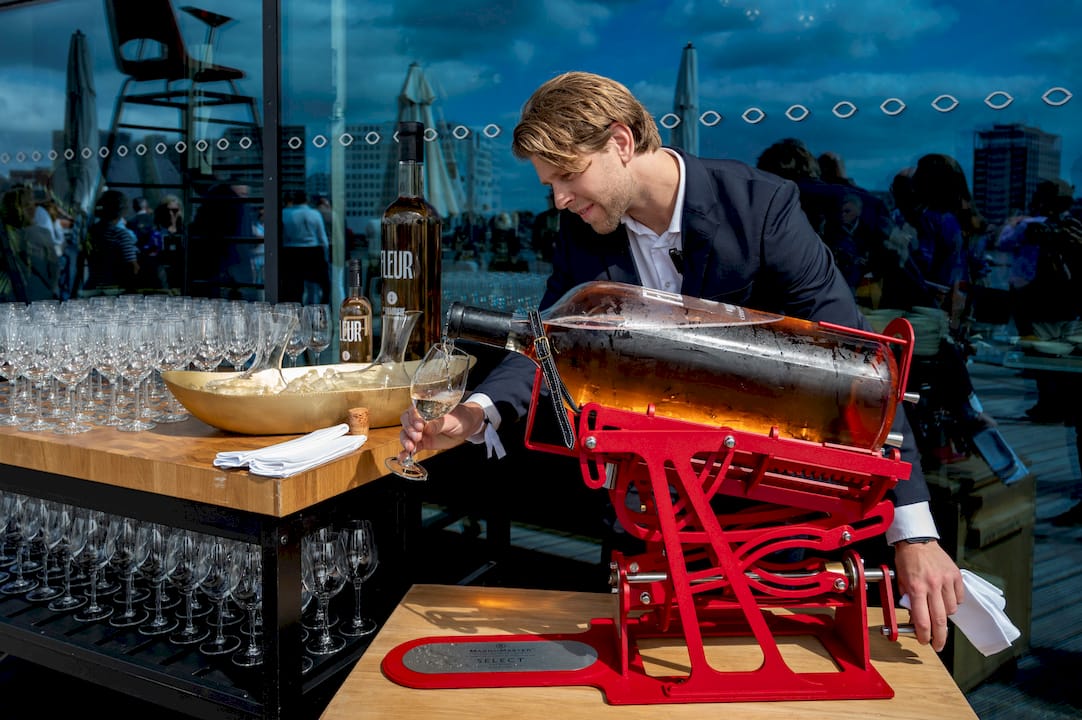
Single Pivot vs Dual Pivot Wine Cradles for Large-Format Wine Bottles
How single-pivot and dual-pivot cradles differ when you pour a magnum or larger, what each does well, and how to choose for your cellar or dining room.
A single-pivot cradle tilts a bottle around one axis. A dual-pivot cradle adds a second pivot, so the bottle’s support and the tilt can move independently as the weight shifts. With a 750 ml bottle the difference hardly matters. With a magnum, a jeroboam or anything larger, it decides whether the pour is a steady, continuous movement or a series of small corrections.
This guide compares the two mechanisms fairly: what each does well, where each runs out of room, and what to look for if you serve large formats at home, in a restaurant or in a hotel. Some of it is ordinary mechanics. Some of it is our own experience building the MagnuMaster, a dual-pivot cradle, in Austria since 2011.
TL;DR
-
A single-pivot cradle rotates the bottle around one fixed axis. It is simple and perfectly adequate for many bottles and many situations.
-
A dual-pivot cradle uses two axes. The aim is to keep the bottle’s weight balanced as it tilts, so one hand can guide a heavy bottle through a smooth pour.
-
The heavier the bottle, the more the pivot geometry matters. A full double magnum (3 litres) weighs several times what a standard bottle does, and the weight shifts the moment you tilt it.
-
The MagnuMaster range covers 0.75 to 30 litres in three models, with engraving included and custom powder coating optional.
-
Neither mechanism is better in every setting. Match the cradle to your largest bottle and to how often you serve it.
Table of Contents
Why the pivot matters more as the bottle grows
Large formats are a pleasure and a handling problem at once. WSET notes that a larger bottle has a smaller ratio of surface area to liquid, so the wine inside comes into contact with less oxygen relative to its volume. That is one reason large formats are prized for long cellaring. The same size makes them awkward at the table.
The awkwardness is physical. A magnum holds 1.5 litres and a double magnum 3 litres. At that scale the bottle is heavy, long and top-heavy once it starts to tilt. Add a deposit that has settled along the bottle’s lower side after years of cellaring, and you have two goals that pull against each other: move a great deal of weight, and move it very gently.
A sound approach to older wine is to keep the bottle’s orientation consistent from cellar to table. The International Wine & Food Society describes the traditional wine basket as holding a bottle at a slight slope of roughly 25 to 30 degrees, enough to ease it out of the rack without stirring the sediment. A basket does that job well. What it does not do is carry the bottle through the pour itself. That part has traditionally been done with two hands, or two people.
How a single-pivot cradle works
A single-pivot cradle holds the bottle in a frame and lets it rotate around one axis, usually near the base or toward the middle of the frame. Tilt the frame and the neck drops toward the glass or decanter.
This is the oldest and most intuitive arrangement, and it has real strengths:
-
Simplicity. One axis means few moving parts, which keeps the mechanism easy to understand, clean and maintain.
-
Predictability. The motion is a single arc. Anyone can learn it in a minute.
-
Good fit for modest weights. For standard bottles, and for magnums handled by a confident server, a well-made single-pivot design can work very well.
The limitation is geometric. With one axis, the bottle’s centre of gravity travels along a fixed arc. As the tilt increases, the balance point relative to that axis changes, and the force needed from your hand changes with it. At the start of the pour you may be lifting. Halfway through, the load can start to pull forward on its own. Near the end you may be holding back. For a light bottle, that variation is trivial. For a full large format, it is the reason people reach for a second hand.
This is not a flaw in single-pivot designs as such. It is the trade-off of the simplest possible linkage, and where the bottle is moderate in size or the server is experienced, it may be no trade-off at all.
How a dual-pivot cradle works
A dual-pivot design adds a second axis, so the motion of the bottle becomes a combination of two rotations rather than one. Engineers use this idea widely. FIRGELLI’s guide to linkages explains that linkages exist to guide a load along a controlled path, and that shallow transmission angles can waste force into the pivot instead of moving the load. Multi-pivot geometries are one of the ways designers manage that.
Applied to a wine bottle, the principle is straightforward. With two axes, the cradle can let the bottle’s weight stay closer to balanced through the tilt, instead of swinging from “heavy to lift” to “heavy to hold back.” The practical aim is a pour in which a single hand can start the movement, guide it and stop it without a sudden change in effort.

That is the idea behind the MagnuMaster. Its dual-pivot mechanism is proprietary and is the main thing that sets it apart. Its purpose is smooth, precise and controlled pouring of heavy bottles, with the slow, continuous movement that helps keep sediment where it has settled.
What the second pivot costs
Honesty matters here. A second axis means more components, tighter tolerances and more careful manufacture. A poorly made dual-pivot linkage can feel worse than a good single-pivot one: slack in either joint shows up as wobble under load. The mechanism is only as good as the machining and the materials behind it, which is why we handcraft the cradle in Austria rather than treating it as a commodity part.
Single pivot vs dual pivot at a glance
| Criterion | Single pivot | Dual pivot |
|---|---|---|
| Number of rotation axes | One | Two |
| Mechanical simplicity | Highest | More components, higher precision required |
| Effort through the tilt | Changes as the centre of gravity moves along one arc | Designed to keep the load closer to balanced |
| Suited to | Standard bottles, magnums, confident handlers | Magnums and above, especially when one hand must do the work |
| Sediment handling | Depends on how smoothly the server tilts | Designed to support a slow, continuous motion |
| Build quality sensitivity | Moderate | High: joints must be tight |
The table describes tendencies, not guarantees. A superb single-pivot cradle will outperform a mediocre dual-pivot one, and no mechanism replaces patience. What the second axis offers is more margin for the person doing the pouring, which matters most when the bottle is large and the audience is watching.
What this means for large-format service
The pour of a large-format bottle is rarely private. WSET observes that the appeal of large formats lies as much in visual and ceremonial impact as in how the wine evolves. A bottle that appears at the table is a centrepiece. If the pour is hesitant, the moment loses something.
Here is where the mechanism shows up in practice.
For collectors at home
You may open a large format only a few times a year, often for a gathering that matters. You will not have practised. A cradle that behaves predictably on the first use is worth more than one that rewards repetition. Dual-pivot designs aim for exactly that: a bottle that is easy to guide the first time, with the same hand you would use for a decanter.
For sommeliers and fine-dining rooms
Service is a performance with a margin for error of nearly zero. Wine Spectator’s advice on decanting a double magnum stresses preparing ahead and keeping the process continuous, since stopping halfway to stand the bottle up risks stirring the deposit. A cradle that supports a continuous, one-handed motion leaves your other hand free for the decanter or the glass.
For luxury hotels and event venues
The same bottle may be poured by different staff over a season. A mechanism that is intuitive for newcomers and consistent from one pour to the next reduces training time and the risk of an accident with an expensive bottle. Engraving, which we include on every MagnuMaster, lets the venue’s name or crest sit on the cradle itself.
Sediment: what a cradle can and cannot do
Sediment is a natural result of ageing in many red wines and some vintage ports. WSET advises that wines with a heavy deposit should ideally be decanted, because the sediment can taste bitter or astringent and looks unappealing in the glass.
A cradle does not remove sediment. What it does is hold the bottle at a controlled angle and let you tilt it slowly, so the deposit stays along the lower side of the bottle while the clear wine leaves through the neck. Smoothness is the key variable. A sudden change in tilt or a small jolt can lift the deposit back into the wine. That is why a mechanism that keeps the movement even matters in this setting, and why we describe the MagnuMaster as helping to minimise sediment disturbance rather than eliminating it. Standing the bottle upright for a period beforehand, as many collectors do, remains good practice for very old bottles.
A word on what the pour also does for the wine: decanting into a vessel exposes it to air. For large formats, which age more slowly, a gentle decant can be a welcome opening-up. How much air is right depends on the wine, and your sommelier or merchant is the right person to ask about a specific old bottle.

Our perspective: why we built a dual-pivot cradle
We started making the MagnuMaster in Austria in 2011 for a simple reason: large bottles deserve a better way to be served than brute strength. We have nothing against simpler cradles, and we do not believe every single-pivot design is poor. Many are well made, and for a light bottle or a practised hand they do the job.
Our view is that the problem changes character as the bottle gets bigger. The moment you tilt a heavy bottle, the load shifts and wants to keep going. A single axis asks your hand to manage that shift. A second axis lets the mechanism manage more of it, so your hand can concentrate on pace and direction. That is the whole idea, and everything else about the MagnuMaster follows from it: the balance, the one-handed operation, the slow, even pour.
We work with collectors, wineries, hotels and sommeliers, and the feedback that matters to us is quiet: someone pours a double magnum for the first time and does not need a second person. We build each cradle by hand, finish it in anthracite with an iron-glimmer effect, and engrave it for you at no extra charge. That is how we think a tool for a ceremonial moment should be made.
— Mathias Laurin Koidl
Choosing the right size: the MagnuMaster range
The mechanism is the same idea across the range. What changes is the bottle capacity the frame is built to carry. All three models also work with standard 750 ml bottles, though most owners buy them for magnums and larger.
| Model | Bottle range | Price |
|---|---|---|
| MagnuMaster L | 0.75 to 6 litres | €2,580 |
| MagnuMaster XL | 3 to 18 litres | €3,300 |
| MagnuMaster XXL | 4.5 to 30 litres | €9,500 |
A quick way to choose:
-
Magnums, double magnums, jeroboams and rehoboams (up to 6 litres): the L covers the whole span, including standard bottles.
-
Imperials, salmanazars, balthazars (from 3 up to 18 litres): the XL is the right frame. If your collection reaches into this territory, it also covers the 3 to 6 litre sizes.
-
Nebuchadnezzars and beyond (5 up to 30 litres): the XXL is built for the heaviest bottles you will encounter.
If you serve a mix of sizes, choose by the largest bottle you expect to own, not the one you have today. You can see the full range on the MagnuMaster collection page.
Finish and engraving
The standard finish is anthracite with an iron-glimmer effect, and personalised engraving is included with every unit. If you want the cradle to match a dining room, a brand colour or a cellar, custom powder-coating is available for an additional €550. Hotels, wineries and corporate clients often use the engraving for a name, a crest or a date, which makes the cradle a considered gift as well as a tool.

How to pour a large format with a cradle
The steps are the same whichever cradle you use, and a few matter more with big bottles.
-
Plan the decanters. Wine Spectator’s advice is to have as many decanters ready as the bottle needs, since the pour should not stop midway. A double magnum fills more than one standard decanter.
-
Prepare the bottle. Remove the foil and cork with the bottle seated in the cradle, keeping its angle consistent with how it lay in storage, as the IWFS describes for a basket.
-
Start slowly. Begin the tilt gently. The first few degrees are where an uneven movement does the most harm.
-
Keep the motion continuous. Avoid stopping and starting. Use your free hand to steady the decanter.
-
Watch the neck. Many people place a light behind the shoulder of the bottle so the first sign of sediment is visible. Stop when it approaches the neck.
-
Return the bottle upright only at the end. Leave the remaining deposit in the bottle.
With a dual-pivot cradle, steps three and four tend to be easier to do well, because the mechanism carries part of the load. With any cradle, a short practice run with an empty or water-filled bottle is worth the five minutes, especially before a dinner service.
Questions to ask before you buy any cradle
Whether you choose a single-pivot or a dual-pivot design, these questions separate a sound purchase from a disappointing one:
-
Is the maximum bottle size stated, and does it exceed your largest bottle?
-
How does the cradle hold the bottle without scratching the glass or the label?
-
Can one hand operate it throughout the pour, with a full bottle?
-
Is the frame rigid under load, with no play in the joints?
-
Can it be finished or engraved to suit your venue?
-
Who makes it, and where?
The patent record shows the idea of a pivoting cradle for liquid containers is long established. US Patent 6575413, for example, describes a base with a pivoting cradle and a stop to limit return movement. What distinguishes one product from another is not the concept but the geometry, the materials and the finish.
FAQ
Is a dual-pivot cradle always better than a single-pivot one?
No. A single-pivot design is simpler and can work very well for standard bottles and for magnums handled by an experienced server. The advantage of a second pivot grows with bottle weight and with how much you rely on one hand. Build quality matters as much as the number of axes.
Can I use a MagnuMaster with a standard 750 ml bottle?
Yes. The L model covers bottles from 0.75 to 6 litres, so it accepts a standard bottle as well as magnums, double magnums and larger formats. Most owners choose it for the larger sizes, where weight and imbalance make pouring hardest.
Does a cradle prevent sediment from reaching the glass?
Not by itself. A cradle lets you tilt the bottle slowly and evenly, which helps keep the deposit settled along the lower side. You still need to stop pouring as sediment nears the neck, and very old bottles benefit from standing upright beforehand.
Is engraving included, and can I choose the finish?
Personalised engraving is included with every MagnuMaster. The standard finish is anthracite with an iron-glimmer effect. Custom powder-coating is available for an additional €550, as described on our finish and engraving page.
Sources
-
What makes magnums special: the science and the joy of bigger bottles (WSET)
-
Frequently asked questions about serving and decanting wine (WSET)
-
Types of Linkages: Complete Guide to Mechanical Linkage Mechanisms (FIRGELLI)
-
How should I decant a double-magnum of a 20-year-old wine? (Wine Spectator)
-
Apparatus for pivotally supporting a liquid container, US Patent 6575413


